


Comparisons between a single-band L1 part and a dual-band L1+L5 part usually get argued on accuracy, and the argument never settles, because both numbers were measured under conditions your product will not see. The way we normally frame it is simpler: a second band does not buy you a better number in the datasheet, it buys you a tighter distribution around whatever number you get. In the places where products actually struggle — beside buildings, under wet canopy, behind glass, low on a vehicle body — that is the difference between a trace that wanders and one that holds.
What follows is closer to how we would explain it across a bench than how it reads on a product page: what L5 changes, the mistakes teams make, and where a dual frequency GNSS module pays for itself.
What a Second Band Actually Changes
Why does adding L5 help when L1 already works?
L1 is the legacy civil band every major constellation transmits, and a single-band design around it is mature and cheap. L5 — with Galileo E5a and BeiDou B2a alongside it — is a second civil band with wider bandwidth and a more modern signal structure. Three consequences matter.
The ionosphere stops being a guess. The delay the ionosphere imposes depends on frequency, so a receiver listening on two frequencies at once can measure the difference and remove most of the error. A single-band receiver applies a broadcast model instead, which estimates a condition that shifts with location, time of day and solar activity.
Multipath behaves better. Wider bandwidth gives a sharper correlation peak, so a signal that bounced off a wall is less able to pull the measured range away from the true one. This is the effect that shows up in city streets and under tree cover.
There is more to work with. Each constellation broadcasting L5 contributes a second usable signal per satellite, which improves geometry and raises the usable-signal count when part of the sky is blocked.
Does dual frequency help in open sky?
Less than the datasheets imply, and this is where we usually talk people out of spending money. Under a clear sky the atmospheric term is small and there is little multipath to fight, so a competent single-band design already performs close to its potential. The gap opens up as the environment gets worse.
Single-Band L1 vs Dual-Band L1+L5: Where the Difference Shows
| Factor | Single-band L1 | Dual-band L1+L5 |
|---|---|---|
| Ionospheric error | Corrected with a broadcast model | Measured on two frequencies and removed |
| Multipath near buildings or canopy | Wider correlation peak, more scatter | Sharper peak, measurably tighter scatter |
| Usable signals per constellation | One civil band | Two civil bands, better geometry under partial sky |
| Tracking current (same module family) | 30–35 mA at 5.0 V | 32–36 mA at 5.0 V |
| What it really costs you | Cheapest antenna, simplest RF path | An antenna covering both bands, more BOM, more RF care |
Read the fourth row carefully, because it is the assumption we correct most often. In the 28 mm family below, the dual-band part draws 32–36 mA at 5.0 V against 30–35 mA for the single-band part — a few milliamps, not a multiple. The penalty sits in the antenna and the silicon, not the current budget.
Four Mistakes We See Teams Make
These come up repeatedly in design reviews, and none of them are solved by buying a more expensive module.
"We moved to dual-band and nothing improved"
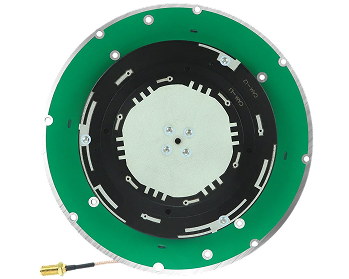
Almost always the antenna. A dual-band module fed by a single-band antenna receives L1 only, so you have paid for a capability you are not using. Check the antenna's specified bands, and the ground plane it was characterised on — behaviour changes once it is shrunk to fit an enclosure.
"The test track showed no difference between the two"
Then the test track was too kind. On an open route the two options converge and you conclude that dual-band is marketing. Run the comparison where the product will actually be used: a street with building frontage, a loading area, a tree-lined path.
"The datasheet current looked fine"
Tracking current is one line in a budget usually dominated by duty cycle. A tracker that wakes once an hour spends most of its life in the backup domain, where 11 µA matters far more than a 2 mA difference at peak. Budget the cycle, not the peak.
"L5 is available everywhere now"
Coverage is good and improving, but how many L5 signals you can track depends on the constellations your market sees and on firmware configuration. Log which L5 signals a candidate acquires at your deployment locations — that count, not the band name, is what you are buying.
How to Settle It on Your Own Bench
Three measurements, in this order, and you will not need to take anyone's word for it:
- Park it and plot it. Fix the antenna at a surveyed point and log for several hours. Judge the scatter plot, not the best-case reading — consistency is the claim, so consistency is what you measure.
- Count the dropouts, not the average. Walk the real route and record how much of the time the receiver holds its best solution state. Two modules with the same average error can differ enormously here.
- Log the L5 signal count. If a dual-band module tracks very few L5 satellites in your region, the second band is idle and the money is better spent on the antenna.
Where a Dual Frequency GNSS Module Earns Its Cost
Our rule of thumb is short. If the antenna sees most of the sky, the requirement is metre-level and the product is cost-sensitive at volume, single-band is the right answer and it is not a compromise. If the product works beside buildings or under canopy, or the requirement is centimetre-level, pay for the second band — and in that last case there is nothing to debate, because RTK resolves carrier-phase ambiguities faster and holds them over longer baselines with a second frequency available.
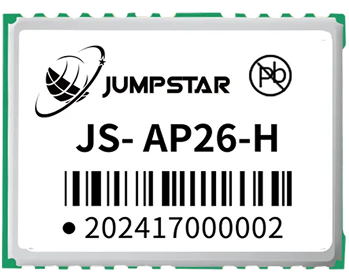
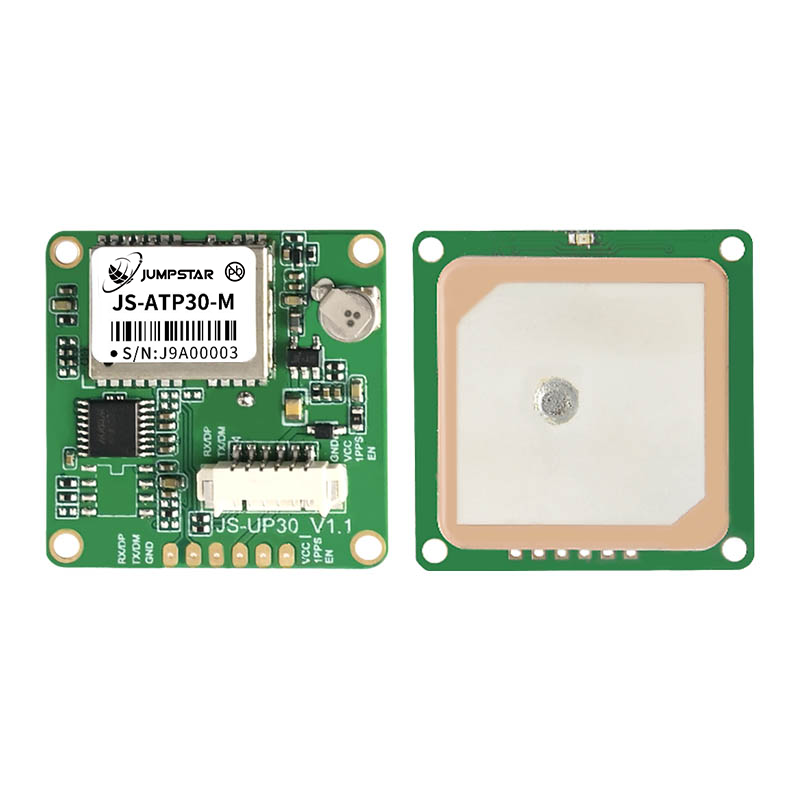
These two are the pair we put side by side when a team is undecided: same 28 mm family, same supply range, same backup current, a few milliamps apart, so the comparison isolates the band.
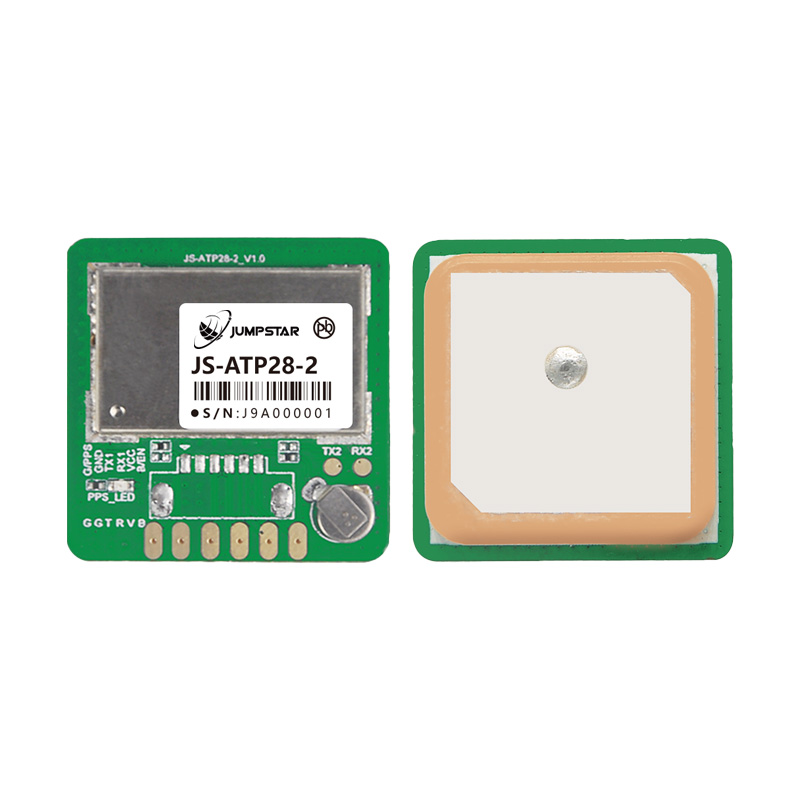
JS-ATP28-2 — Single-Frequency L1
- 28.0 × 28.0 × 7.0 mm ±0.3 mm
- 2.8–5.5 V; 30–35 mA at 5.0 V
- Backup 11 µA at 3.3 V
- PPS, UART (TXD/RXD), VBAT/EN
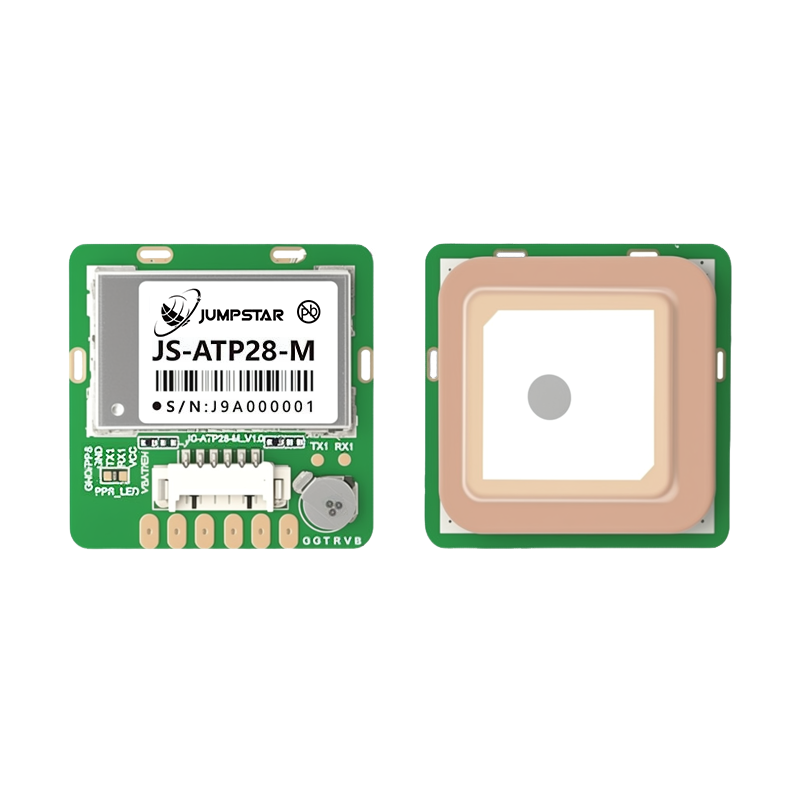
JS-ATP28-M — Dual-Band L1+L5
- Horizontal accuracy 1.0 m (L1+L5), 2.5 m (L1 only)
- 135 channels (L1:75 + L5:60)
- 2.8–5.5 V; 32–36 mA at 5.0 V
- Backup 11 µA at 3.3 V
That 1.0 m against 2.5 m is the same hardware measured two ways, which is why we quote it rather than a generic claim: the difference belongs to the band, not to a better antenna or a different board. The ratio is not constant — it narrows in open sky and widens in a street canyon — but it is the cleanest number available for what a second band is worth.
Two variants come up often. Where a team has no RF layout capability, a dual-band module with the antenna integrated, such as the JS-ATP45-M, removes the matching network and connector from the design. And where the requirement is RTK, start from a dual-band RTK part like the JS-RK26-3, rated at 1.0 cm + 1 ppm CEP horizontal in a 16.2 × 12.2 mm footprint.
Questions Buyers Ask Most Often
Do I need a dual frequency module for RTK?
Not in principle — single-band RTK exists — but in practice, yes. A second frequency makes ambiguity resolution faster and holds the fixed solution over longer baselines. If your product must fix quickly after power-on, or work far from the reference station, single-band will frustrate you.
Will L1+L5 work with the antenna I already have?
Only if that antenna covers L5. It is the most common disappointment we see: the module is dual-band, the antenna is not, and the receiver never acquires a second signal. Confirm the antenna's band coverage before ordering anything.
Can L5 be switched on later with a firmware update?
No. The receiver front-end has to be able to process the band; firmware only decides which constellations and signals are enabled. If you think L5 may be needed within the product's life, specify the hardware now.
Is dual-band worth it for a tracker that reports once an hour?
Usually not, unless the device spends its working life in cities or under cover. The current cost is negligible — a few milliamps — so the real question is the antenna and the enclosure, not the power budget. In open terrain, put the money into a better antenna instead.
For background: what each band carries is covered in multi-constellation GNSS frequency bands, and the antenna side in how to select a GNSS antenna.
Conclusion
Single-band L1 remains a legitimate engineering choice, and the standard-precision range exists because plenty of products genuinely do not need more. The case for a dual frequency GNSS module is environmental: partial sky, reflective surroundings, canopy, or a centimetre-level requirement. Where RTK is the target the decision is made before the discussion starts — begin with the high-precision RTK modules and work back to size and power.
Still weighing L1 against L1+L5?
Send us the conditions your product will actually face — sky view, enclosure, current budget, target accuracy — and our engineers will tell you whether the second band earns its place in your build.
.png?imageMogr2/format/webp)
.png?imageMogr2/format/webp)
.png?imageMogr2/format/webp)
.jpg?imageMogr2/format/webp)