




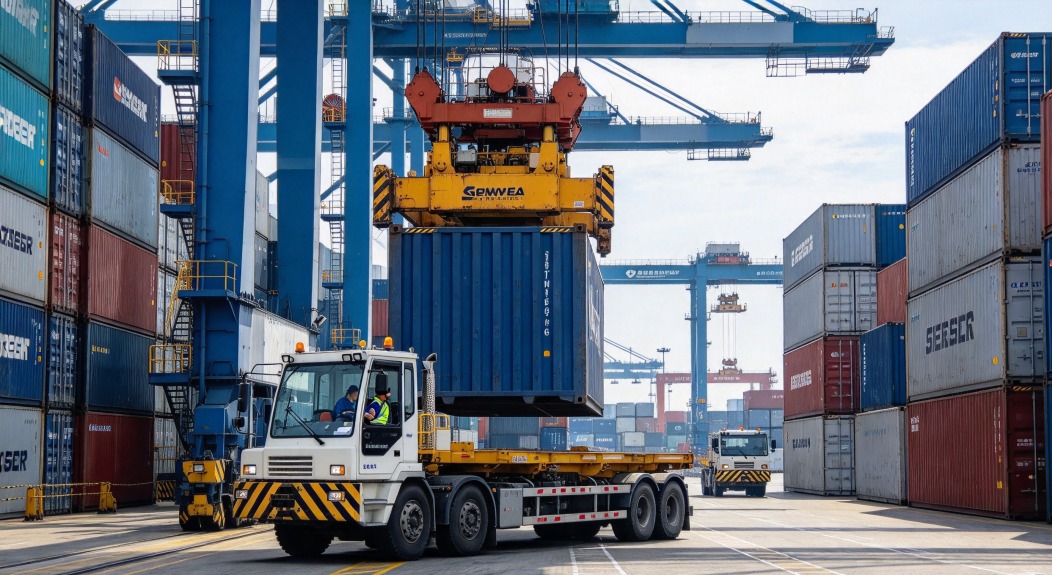
A container terminal is judged on moves per hour. The crane is rarely what limits it. What limits it is the last metre — whether the spreader lands on the four corner castings, whether the truck stops at the right bay, whether the gantry knows which row it is standing over.
That last metre is not a crane problem. It is a positioning problem, and it is the part most automation budgets underestimate. This is how we look at container terminal RTK when a terminal asks what it can actually do for them.
Why the Last Metre Costs More Than It Looks
A standard 20-foot box weighs tens of tonnes. The work cycle is only three moves: lift, align, set down. Every one of those moves depends on knowing where two objects are relative to each other, to a few centimetres, while both are moving.
When that knowledge is missing, the cost does not appear as "a small error". It appears as a spreader that comes down twice on the same box, a gantry that has to reverse out of a row, a truck that waits because the bay it was sent to is already occupied. Multiply that by a shift and it becomes moves per hour, then vessel turnaround time. Terminals feel positioning errors in throughput, not in millimetres.
Four Places Accuracy Disappears
When a terminal tells us their automation "works but is not reliable", the cause is almost always one of these four, and they fail for different reasons.
1. The grab: spreader to corner casting
The tolerance here is unforgiving because the target is four small castings, not the box as a whole. A position that is good to 20 cm at the truck can be 20 cm wrong at the spreader, because the spreader hangs on ropes and moves independently of the machine that carries it. Measuring the gantry is not the same as measuring the spreader.
2. The travel: truck, IGV and gantry
Horizontal travel errors look harmless until a vehicle is sent to the wrong bay. In a stacking yard, one bay off is not a small detour — it is a re-handle. Gantry long-travel is the same story at a larger scale: a machine that drifts half a metre per row accumulates into a wrong row by the end of the block.
3. The blind zone: under the boom, between the stacks
Under a quay crane boom, or inside a block of high stacks, the sky view collapses. This is not an occasional fault; it is the normal working condition of the equipment that most needs the position. A receiver that reports "no fix" exactly where the work happens is not a receiver problem you can tune away.
4. The plan: which box, which move, which truck next
The last failure is not a coordinate at all. If the position, the heading and the machine identity do not reach the dispatch system in a usable form, the control room is still planning on a whiteboard. Positioning that stays inside the device has no operational value.
| Failure | What the operator sees | First thing to check |
|---|---|---|
| Spreader misalignment | Box lifted twice, corner casting damage | Antenna measures the gantry, not the spreader |
| Travel error | Wrong bay, extra re-handle | Drift per row rather than single-point accuracy |
| Blind zone | Position drops under the boom | Sky view where the antenna is mounted |
| Plan mismatch | Dispatch still running on radio | Protocol and update rate reaching the platform |
What Container Terminal RTK Has to Measure
It is not one number. A machine that carries a spreader needs six: position in three axes, plus heading, pitch and roll. Position alone tells you where the machine is. It does not tell you which way the chassis is pointing, and on a truck that has to reverse into a bay, or a gantry that has to stay parallel to a row, heading is the difference between a clean move and a correction.
This is why dual-antenna heading matters in a terminal more than it does in a car. Two antennas separated by a known baseline compare the carrier phase of the same satellite signal; the angle between the baseline and the satellite direction gives the vehicle attitude. The accuracy scales with the baseline: with a 1 m separation the heading figure is around 0.15°, and it degrades as the baseline shortens. A short baseline is not "free" — it is the first thing to check when heading looks noisy.
Our own terminal part, the A12, is specified this way: heading (0.15/R)° and pitch (0.25/R)°, where R is the baseline in metres. That formula is more useful than a single headline number, because it tells you the design constraint instead of hiding it.
Where RTK Stops and the IMU Takes Over
Every terminal automation project eventually reaches the same conversation: what happens when the satellites disappear. The honest answer is that RTK stops, and something else has to carry the position.
An IMU does this by integrating acceleration and rotation. It is excellent over seconds and poor over minutes, because the error grows with time. On the A12 the specification is explicit: centimetre-level for 3 seconds after signal loss, metre-level for 10 seconds. That is a bridge across a boom or a stack, not a navigation system.
The common mistake is to read those numbers as a guarantee of continuous centimetre accuracy. They are not, and no inertial system in this class can be. What they buy is continuity — the dispatch system keeps receiving a plausible position instead of a gap, so the vehicle is not ordered to stop and the track does not break.
The Infrastructure Nobody Budgets For
RTK is a differential technique, which means half of the system is not on the vehicle. A terminal that buys terminals but not a reference station has bought a metre-level receiver with a centimetre-level label.
Three infrastructure decisions decide whether the accuracy survives contact with a real yard:
- Where the reference station sits. It needs a stable, known coordinate and a clear sky view. Putting it on a warehouse roof next to a mast is a common shortcut that quietly degrades every rover in the yard.
- How corrections reach the machine. NTRIP over the terminal's 4G network is the usual route, with RTCM 3.x as the message format. Coverage holes behind stacks are a network problem, not a receiver problem, and they show up as intermittent float solutions.
- What the antennas can see. Water and container steel are both excellent reflectors. A roof-mounted antenna at the edge of a block receives the direct signal plus a delayed reflection, and no amount of receiver quality removes a multipath error that arrives at the antenna. Height and position of the antenna are part of the accuracy budget.
If you want the wider picture of how these pieces fit into terminal operations, the overview of RTK receivers in smart port operations covers the system level.
Two Parts That Fit This Job
When a terminal asks us to equip a mixed fleet — quay cranes, gantries, IGV and trucks — the pairing we usually start from is a dual-antenna terminal plus a survey-grade antenna. Not because it is the most accurate combination on paper, but because it is the one that survives the mounting positions these machines actually offer.
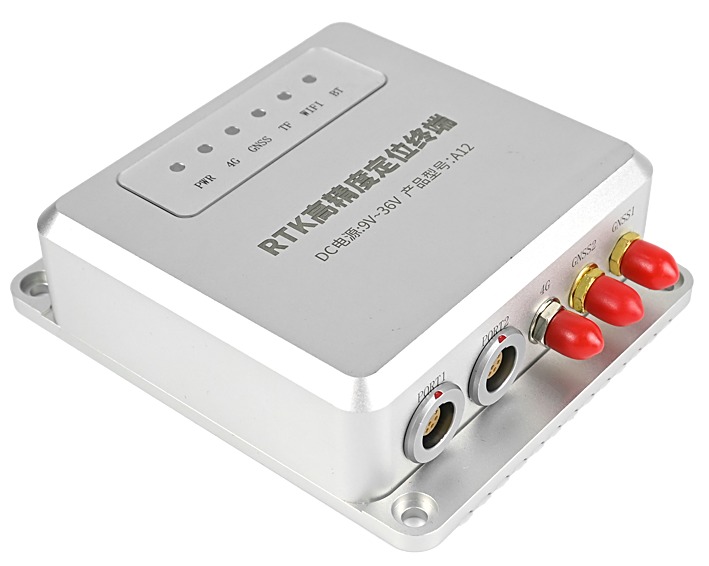
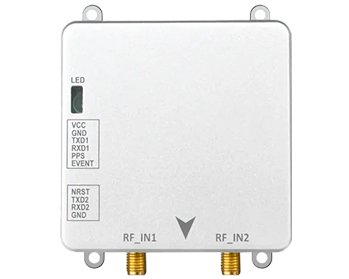
A12 — Dual-Antenna RTK Terminal
- RTK 2 cm ± 1 ppm; heading (0.15/R)°
- IMU: 3 s cm-level, 10 s metre-level
- DC 9–36 V, ≤300 mA at 12 V, IP66
- 108 × 92 × 30.5 mm, 270 g, aluminium
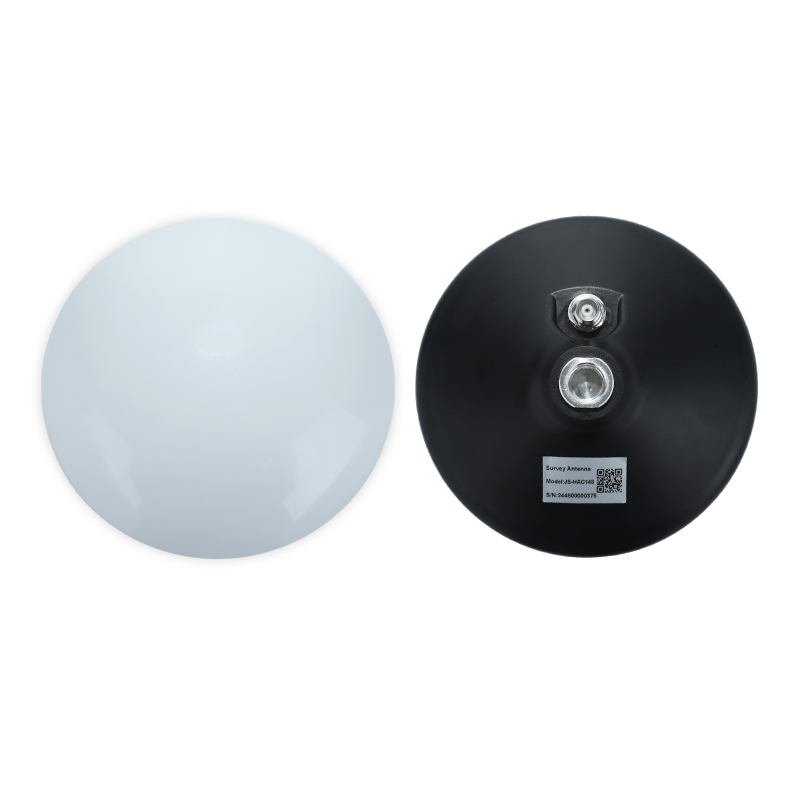
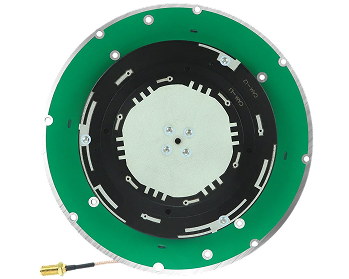
JS-HAC148A — Survey-Grade Antenna
- Phase centre error ≤2 mm
- Gain 4.5 dBic max; LNA 38 ± 3 dB
- Ø148 × 57.7 mm, TNC-K, magnetic base
- IPX6, −40 to +85 °C, ≤30 mA
Both sit in the same working family: the terminal takes vehicle power directly and reports over JT/T 808-2013, and the antenna is a magnetic-base unit with a stable phase centre, so it can go on a crane trolley or a truck roof without a custom mount. You can see the rest of the range in vehicle GNSS terminals and vehicle and fleet antennas.

How We Would Prove It Before Signing
A terminal should not accept a positioning claim from a datasheet. Three tests, run on the machines that will actually use it, settle the question in a week.
- Static scatter, 24 hours. Park the machine, log the position for a full day, and plot the distribution rather than the best case. You are looking for the spread and for time-correlated drift, not the single number in the brochure.
- Blind-zone timing. Drive the machine under the boom and into a high-stack block with a stopwatch and a log. Measure how long the solution actually holds, and whether it returns to a fixed solution quickly on the way out.
- Heading versus a known baseline. Put the machine on a surveyed line and compare reported heading at several orientations. If the error grows as the baseline shrinks, the mounting is the problem, not the firmware.
Questions Buyers Ask Most Often
Do we need our own base station, or can we use a CORS service?
Either works if the correction reaches the machine reliably. A local reference station gives you control and no subscription, but it needs a good site and maintenance. A CORS service removes the hardware and adds a dependency on network coverage inside the yard — which is exactly where coverage is weakest.
How long can the IMU really hold the position?
Seconds, not minutes. On this class of equipment, expect centimetre-level for about 3 seconds and metre-level for about 10. Treat it as a bridge across an obstruction, and design the process so the machine does not need to complete a critical move inside that window.
Can we keep the antennas we already have?
Only if they cover the bands you are using and hold a stable phase centre. A communications antenna will receive GNSS and give you a position, but its phase centre wanders with temperature and mounting, which is the part that matters for centimetre work.
Will it connect to our TOS or dispatch platform?
That depends on the interface, not the accuracy. A device that speaks JT/T 808-2013 and exposes RS232 or CAN can usually be integrated without replacing the platform, which is the part of container terminal RTK that decides whether the project ships. Ask for the protocol document before the pilot, not after.
Equipping a terminal fleet?
Tell us the machines, the mounting positions and how your dispatch system receives data. We will tell you where RTK will hold and where it will not — including the cases where a different sensor belongs on the machine.
.png?imageMogr2/format/webp)
.png?imageMogr2/format/webp)